







This summer’s word-of-mouth movie is a quirky delight. It’s sheep. Who are detectives. Solving a murder mystery. You’re just about guaranteed to cry at the end.
It’s a gentle film. Shepherd George Hardy has a motley flock of sheep. Each one is an individual, with their own distinct personality, and each one has a name. The only exception (misty-eye alert) is the tiny, grubby Winter Lamb.
Lambs are born in the spring. The rare exceptions, the winter lambs, are not welcomed by the flock. They’re loners; they’re misfits. They don’t belong.
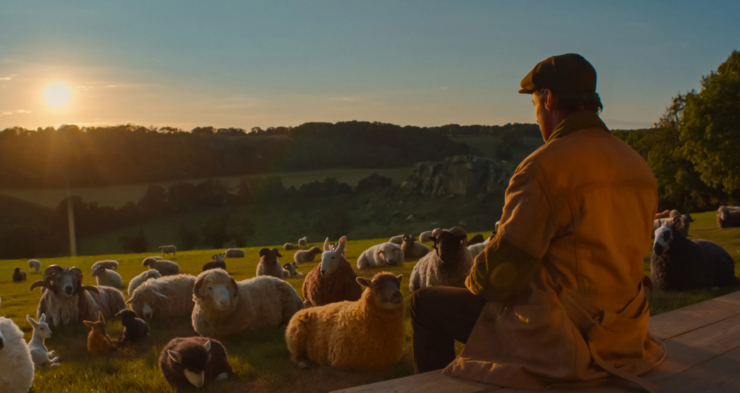
George takes meticulous care of his sheep. He feeds them, medicates the ones who have a disease called Orf, and makes sure they’re all safe and happy. In the evenings, as the sun goes down, he sits outside his caravan (or RV or trailer as we say in the US) and reads to them. Mostly, he reads murder mysteries. As he writes to someone dear to him, whose name is Rebecca, he can almost imagine that they listen and understand. But that can’t be true, because after all, as special as they are, they’re still sheep.
As soon as George stops reading at a cliffhanger and heads to bed, the whole perspective shifts. The sheep start talking—discussing the book, debating the plot, arguing about who did it. Lily, the smartest sheep in the world, declares she knows—and it’s not the one the others think it is.
Lily is one of George’s two favorites. The other is the largest ram, Sebastian. Sebastian is more than a little feral. He comes and goes as he pleases. When he’s on the property, he stands on a high rock and looks down on the flock.
One dark and stormy night, tragedy strikes. The sheep find George in the morning, lying outside his caravan, dead. Lily is sure he’s been murdered.
The sheep set out to solve the crime. They’re well versed in the rules of the mystery genre. They recognize the tropes; they’ve seen multiple examples of detectives in action. They know what to look for, and how to interpret what they find.
There’s one big problem. The murderer is human, and the sheep have to find a way to guide the human police toward the correct answer. That’s a challenge: Officer Tim Derry is, in George’s estimation, an idiot, and he’s never had to solve a murder. He hardly even knows where to start.
But as with the rest of the film’s cast, both sheep and human, there’s more to Tim than meets the eye. Tim may not be very smart, and he doesn’t know much at all, but he can learn. He can change and grow.
Lily, Sebastian, and Mopple leave the farm—not at all easily in Lily and Mopple’s case—and foray into the village of Denbrook, where they’ll find the means of the murder, the motive, and, in the end, the opportunity: the three main elements of the classic murder mystery.
Lily is the smartest of the sheep detectives, and Sebastian is the solitary hero, the leader and guide. Mopple is something altogether different. He has what his fellow sheep consider to be a terrible affliction. He remembers everything. He’s incapable of forgetting.
Sheep in this universe have a unique characteristic. They can choose to forget. If a memory is too painful, they get together and agree. On a count of three, they erase it. It’s gone.
Only Mopple remembers. He doesn’t correct his fellow sheep when they make up stories about what they’ve forgotten. He simply nods and lets them believe what they need to believe.
It’s Sebastian who challenges the assumption that sheep aren’t made for emotional pain. Some things have to be remembered. They’re too important.
Sebastian has a profound belief in justice. He forces the flock, and especially Lily and Mopple, to face hard truths. He makes them see why forgetting is not always a virtue.
One of the most cherished stories sheep tell each other is that they don’t die. They transform into clouds. They’re the power behind storms.
Yes, Mopple says when Lily asks, not meeting her eye. It’s true. Sheep turn into clouds. That’s what happened to her parents. She needs to believe it, and he doesn’t try to disillusion her.
It comes as a profound shock when George turns up dead. Humans die, Mopple admits. They stop living. They don’t come back.
Lily and Mopple’s world expands tremendously and at times painfully as they go about finding the murderer. They discover a whole universe of new ideas: a town beyond their meadow, a dangerous and deadly conspiracy, a thing called a carnival that is both delightful and horrible, and a human concept called God, which appears to be a sort of hybrid animal monster made of bread. Humans eat him on Sundays.
“Poor God,” says Mopple.
The heart of the film is Sebastian’s declaration when the sheep propose to erase their memory of George:
The good should not be harmed by the bad. The weak should not be harmed by the strong. And a friend should never be forgotten.
Everything the sheep do, every clue they follow and every mystery they solve, revolves around these three principles. And justice, Sebastian reminds them. Justice for George, and for the flock.
Talking-animal stories often revolve, or maybe one should say devolve, around human skepticism. The animals have human-level intelligence and awareness, but humans don’t believe it. Either they don’t want to, or they can’t. When animals talk, all they hear is animal noises: in this instance, sheep bleating.
There is a definite element of disbelief here. George doesn’t think the sheep really listen to what he reads them. But the people who come after him, who discover who killed him and why, come face to face with evidence of the sheep’s intelligence—and realize what’s happening. Better yet, they accept it.
That’s rare. It’s disconcerting at first, but once they decide to go along with it, they seem to find the joy in it. They cooperate willingly. After all, it’s in a good cause.
In the end, humans and sheep discover they have a very big thing in common. They share a fundamental need to be a part of something larger. Or as George puts it, in his book that Rebecca reads to the flock:
Like humans, they cherish belonging above all. They allow themselves to belong to us. And so we find we belong to them.

As I’ve said a few times: I did not go into the movie expecting to cry, and yet I did — multiple times.